One Platform
Multiple Smart Glazing Technologies
One Platform
Multiple Smart
Glazing
Technologies
No single smart glazing technology
can solve every challenge.
Every project has different requirements for privacy, energy efficiency, solar shading performance, and user experience.
VSION believes that the future lies not in a single product, but in a technology platform.
Based on our portfolio of PDLC, Reverse PDLC, Black PDLC, and EC technologies,
we provide smart glazing solutions optimized for each space and application.
-
Normal PDLC
The Proven Industry Standard
Normal PDLC is currently the most widely used smart glazing technology worldwide. It remains opaque when the power is off and turns transparent when power is applied, providing instant privacy switching and reliable performance. In meeting rooms, hospitals, hotels, offices, and commercial facilities, proven reliability and ease of maintenance are often more important than advanced features. Normal PDLC has become the most thoroughly proven smart glazing solution for these environments.
VSION’s Normal PDLC delivers stable quality even in large-scale installations through its high transparency and excellent optical uniformity. Supported by a Roll-to-Roll manufacturing system, it also offers the production capacity required for global projects.
VEXA Key Advantages
- Proven smart glazing standard technology
- Excellent optical uniformity across large surfaces
- Roll-to-Roll mass production system
- Fast response time and high durability
- Applicable to smart windows, partitions, and laminated glass systems
-
Reverse PDLC
The Future Standard of Smart Glazing
Reverse PDLC is a next-generation PDLC technology that remains transparent when the power is off and switches to opaque only when needed. Unlike conventional smart films, it maintains an open and transparent environment without consuming power during normal operation, offering outstanding energy efficiency.
VSION’s Reverse PDLC combines world-class response speed with stable operating performance to deliver both instant privacy switching and energy savings. It is gaining recognition, particularly in sustainable buildings and smart mobility applications, where minimizing energy consumption while enhancing user experience is essential.
Reverse PDLC goes beyond conventional smart films, setting a new standard for the future of smart glazing.
VEXA Key Advantages
- Remains transparent when the power is OFF
- Energy-efficient design with minimal power consumption
- Instant privacy switching
- World-class response speed
- Designed for sustainable buildings and Zero Energy Building (ZEB) applications
-
Black PDLC
Beyond Privacy. Designed in Colors.
Black PDLC is a premium smart glazing technology developed to provide privacy protection, solar control, and sophisticated toned-down colors in a single solution. Unlike conventional PDLC, which turns white when opaque, Black PDLC creates a deep black shading effect that delivers a more refined and premium spatial experience. In applications such as automotive panoramic roofs, aircraft cabins, premium residential spaces, and commercial environments, privacy, glare reduction, and heat blocking are equally important.
VSION’s Black PDLC is engineered to meet these demands while maintaining outstanding optical quality and durability.
VEXA Key Advantages
- Combines privacy protection with solar shading
- Reduces glare and solar heat gain
- Elegant deep black appearance
- Optimized durability for mobility applications
- Creates a premium spatial experience
-
Electrochromic (EC)
Continuous Light & Heat Management
Electrochromic (EC) is a next-generation smart glazing technology that continuously adjusts the transmittance of glass through electrochemical reactions, actively controlling both light and heat. While PDLC provides instant privacy switching, EC precisely regulates solar radiation and heat gain to improve energy efficiency, indoor comfort, and user experience simultaneously. As sustainability and energy performance become increasingly important, EC is recognized as a key smart glazing technology for high-end architecture, mobility, and future-oriented environments.
Building on its proven PDLC technology and manufacturing expertise, VSION is expanding its portfolio to include EC technology, providing customers with a broader range of optimized smart glazing solutions.
VEXA Key Advantages
- Continuously adjustable light transmittance
- Active control of solar heat and light
- Improved energy efficiency
- Enhanced indoor comfort
- Core technology for next-generation smart glazing
What is PDLC Film?
PDLC film consists of a polymer layer with liquid crystal molecules dispersed between transparent ITO electrodes.
When an electrical signal is applied, the liquid crystals align in a uniform direction,
allowing light to pass through and making the film transparent. When the power is turned off,
the liquid crystals become randomly arranged, scattering light and turning the film opaque.
PDLC technology is available in two types: Normal PDLC, which becomes transparent when powered and opaque when power is off,
and Reverse PDLC, which remains transparent during normal operation and turns opaque only when required.
Normal PLDC
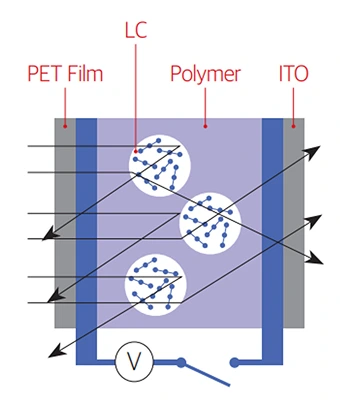
고분자 액정 방울 내 액정 분자들이 자유롭게 분표하며 빛을 산란시킴
Reverse PLDC
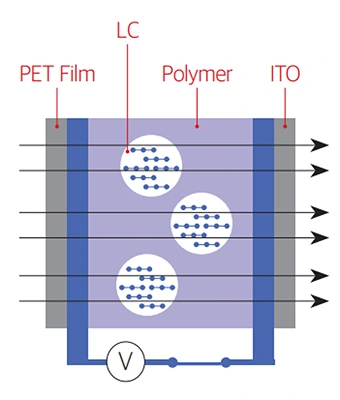
고분자 액정 방울 내 액정 분자들이 일렬로 정렬하며 빛을 통과시킴
It also offers outstanding energy-blocking performance for Zero Energy Buildings.



Simulation Results Based on VSION’s In-House Analysis
(Based on Approximately 1,000 sqm of Window Area)- 800,000
- 700,000
- 600,000
- 500,000
- 400,000
- 300,000
- 200,000
- 100,000
- 0
- 250,000
- 200,000
- 150,000
- 100,000
- 50,000
- 0
- 100,000
- 80,000
- 60,000
- 40,000
- 20,000
- 0
| Item | Baseline (Without PDLC) | PDLC Installed (OFF Mode) | PDLC Installed (Mixed ON Mode) (Assuming 5 hrs/day) |
Remarks |
|---|---|---|---|---|
| Cooling Electricity Consumption (kWh/yr) | 226,667 | 86,133 | 95,258 | OFF mode reflects SHGC improvement only |
| Electricity Cost (KRW/yr) | 29,466,710 | 11,197,290 | 12,383,490 | Based on KRW 130 per kWh |
| Cooling Energy Savings (Carbon Emissions Reduction) | - | 62% | 58% | Compared to baseline |
| Product Cost (Film Only) | - | 150,000 | 150,000 | Subject to installation and supply conditions |
| Estimated Payback Period (Years) | - | Approx. 8.2 years | Approx. 8.8 years | Based on electricity cost savings |